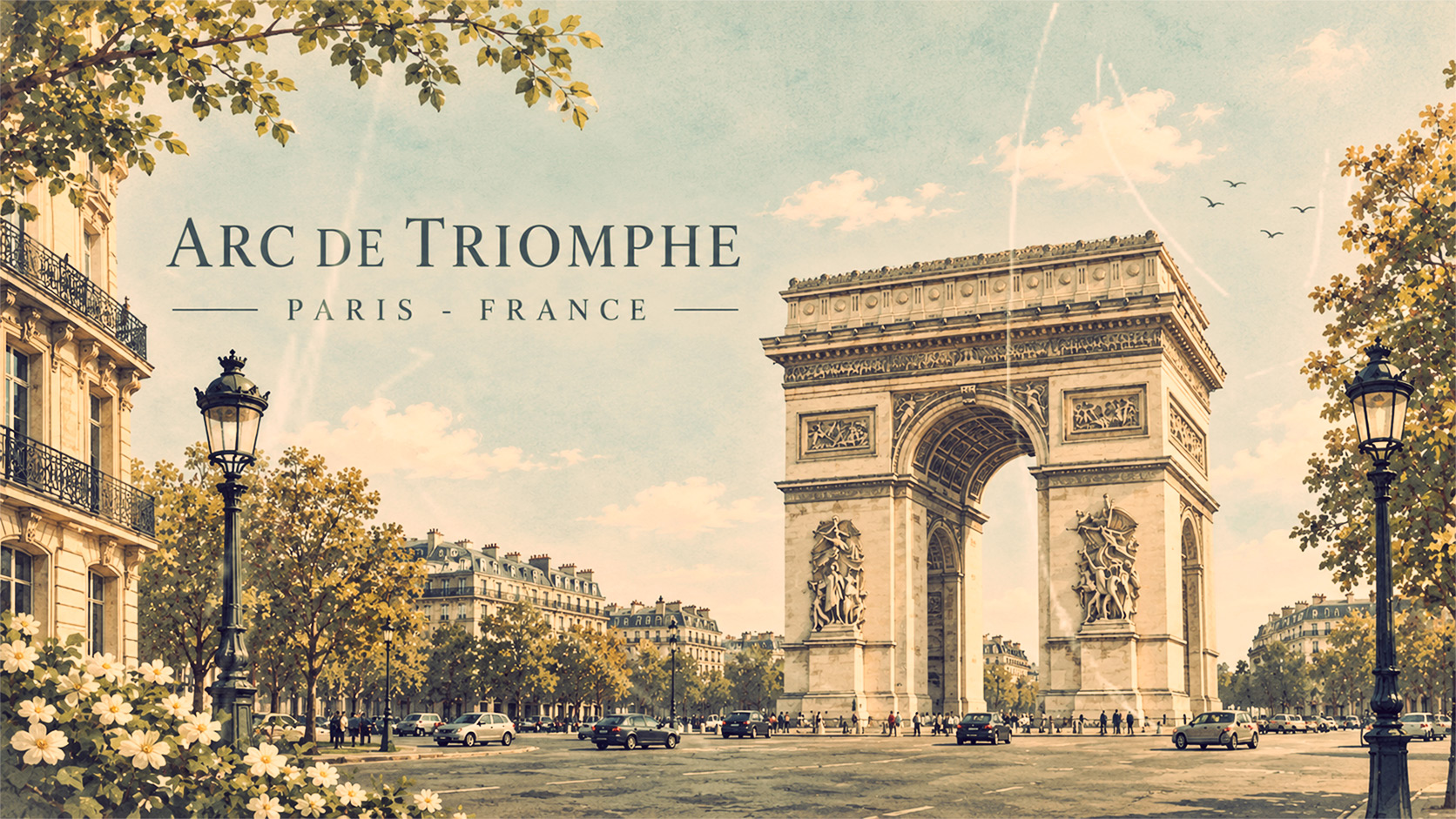
06Grande Armée Avenue Façade
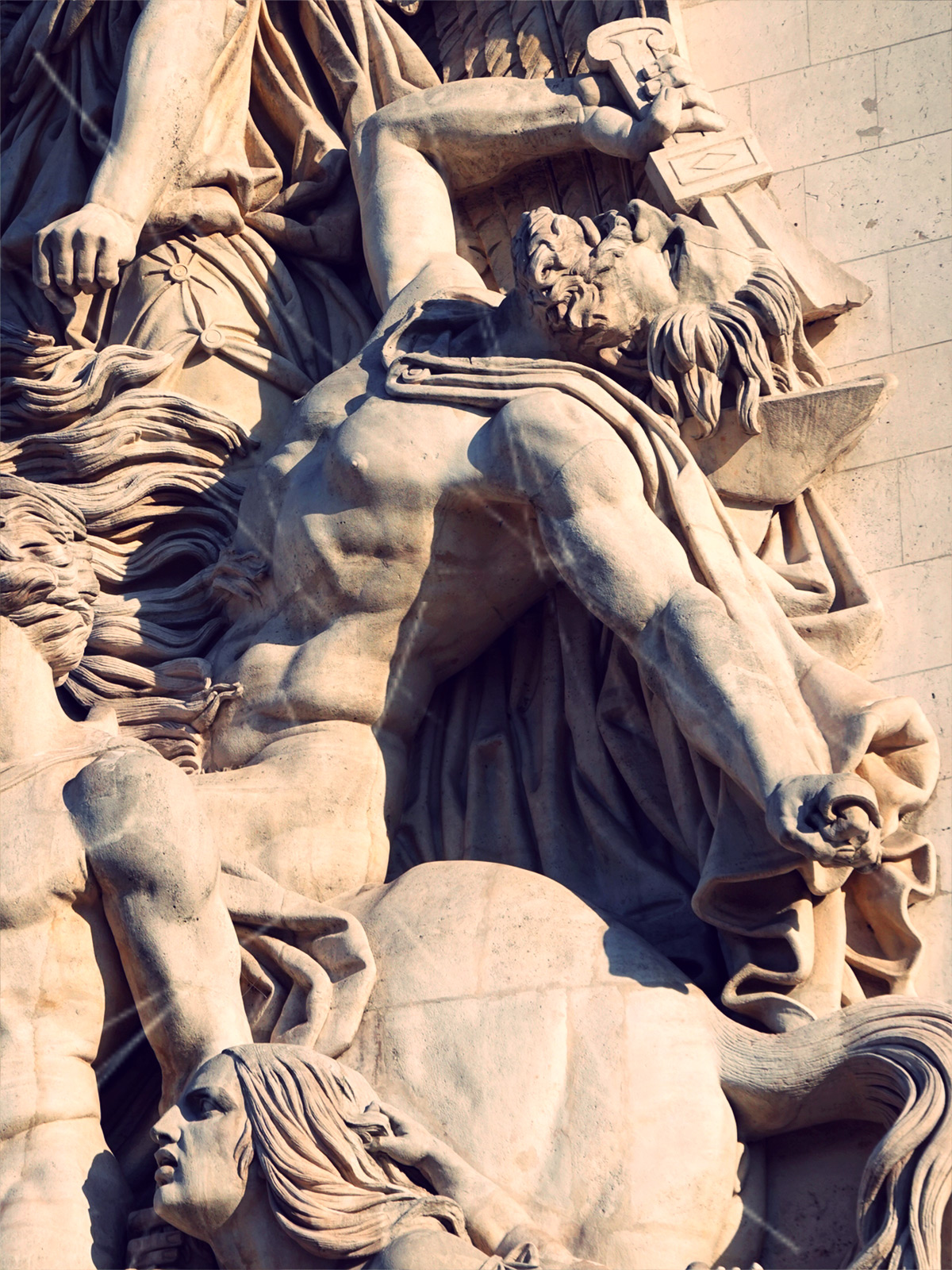
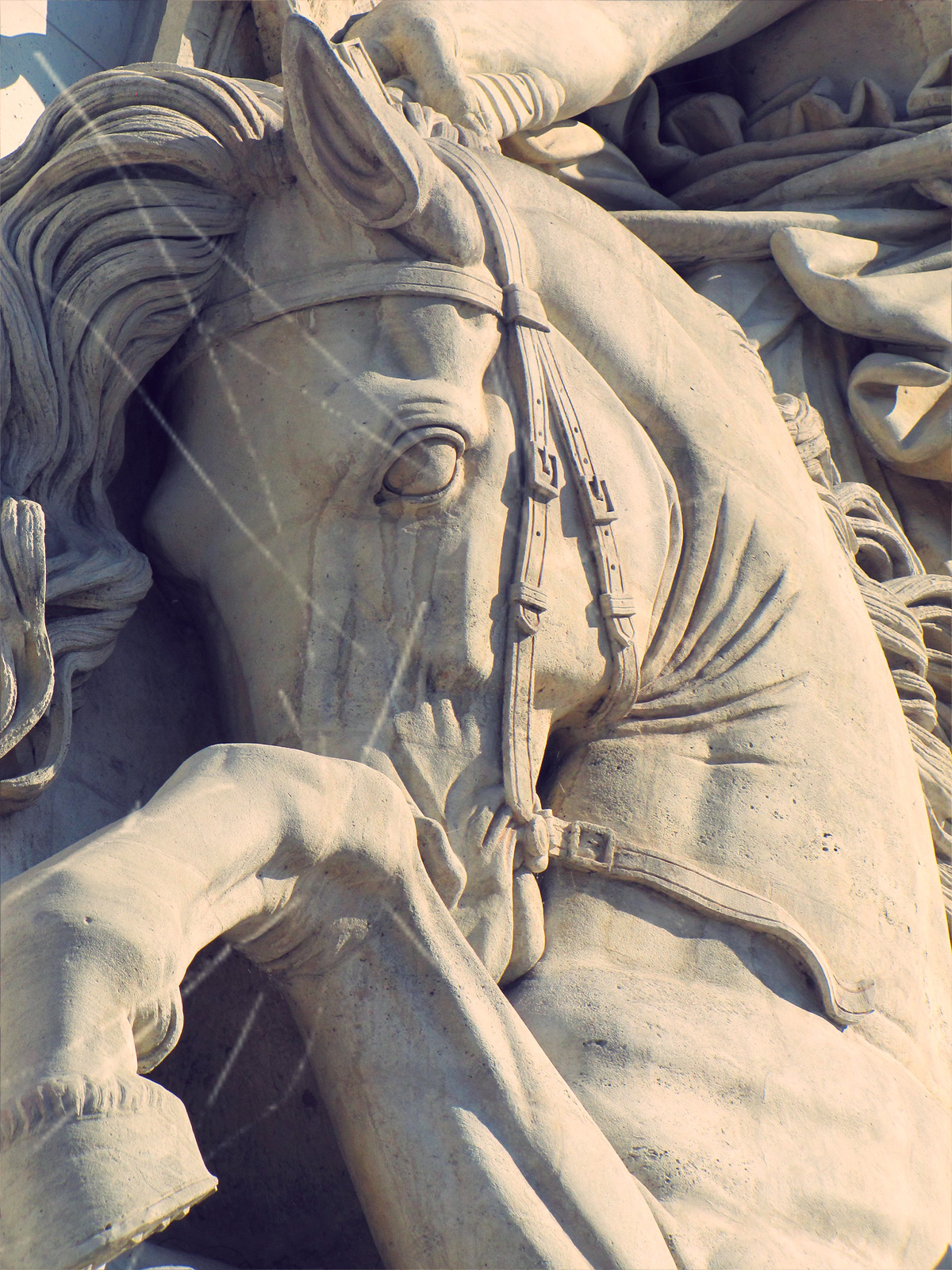
On the right: The Resistance
| Sculptor | Antoine Etex (1808-88) |
| Year | 1837 |
| Location | West Façade, Neuilly Bridge Side |
| Evocation | The Resistance to the invasion by the austro-russian armies in 1814. |
This work expresses a powerful idea: what do we owe to our homeland? When the homeland is threatened, the
duty to defend it can prevail over individual interests, family ties, and even the instinct for survival.
But Etex does not depict an ordinary battle.
He portrays the internal conflict of a man torn between his patriotic duty and his love for his family.
Around him, pain, sacrifice, and the call to resist compose a dramatic image of the nation in danger.
Historical context: France invaded in 1814
In 1814, the Napoleonic Empire was in difficulty after several years of war.
The coalition armies, notably Russian, Austrian, and Prussian, entered French territory.
Despite Napoleon’s final military campaigns, Paris fell into Allied hands on March 31, 1814.
Napoleon abdicated a few days later.
The high-relief sculpture was created nearly 20 years after these events, during the July Monarchy of
Louis-Philippe.
It forms part of a monumental programme intended to commemorate different periods of French national history,
from the Revolution to the Empire.
The title "The Resistance" therefore does not refer to the French Resistance of the Second World War.
Rather, it refers to the defence of French territory during the invasion of 1814.
The scene nevertheless conveys a broader message: it evokes the courage of those who defend their country
when war threatens their homes and their future.
The meaning of the characters
- The young warrior: the duty to defend the homeland -
At the centre of the composition, a naked young man stands holding a sword in his right hand, his left fist
clenched.
His body is tense with anticipation of action: he seems ready to go into battle.
His nudity does not mean that he is unarmed or defenceless.
It draws on the classical tradition, in which the heroic body expresses strength, courage, and virtue.
By depicting his figure without contemporary military dress, Étex gives the character a universal significance.
The clenched fist represents determination.
The sword materializes his commitment: he does not merely lament the invasion, but prepares to act.
The young man embodies the citizen who accepts the risk of his life to defend the homeland and those who
live there.
- The old man: the love of family and the fear of losing his son -
On one side of the warrior, an old man clings to his leg, attempting to hold him back.
He is generally interpreted as the young man’s father.
His gesture is particularly poignant: he does not seek to fight the enemy, but to prevent the young man from
leaving.
He represents the attachment to life, the wisdom of age, and the fear of seeing a beloved being disappear.
The contrast between the two characters is fundamental.
The young warrior looks towards his duty; the old man holds him back in the name of family bonds.
Étex does not present this opposition as a simple contrast between cowardice and courage.
He brings to light the human cost of patriotism: to defend his homeland, the soldier may have to leave behind
those who wish to keep him close.
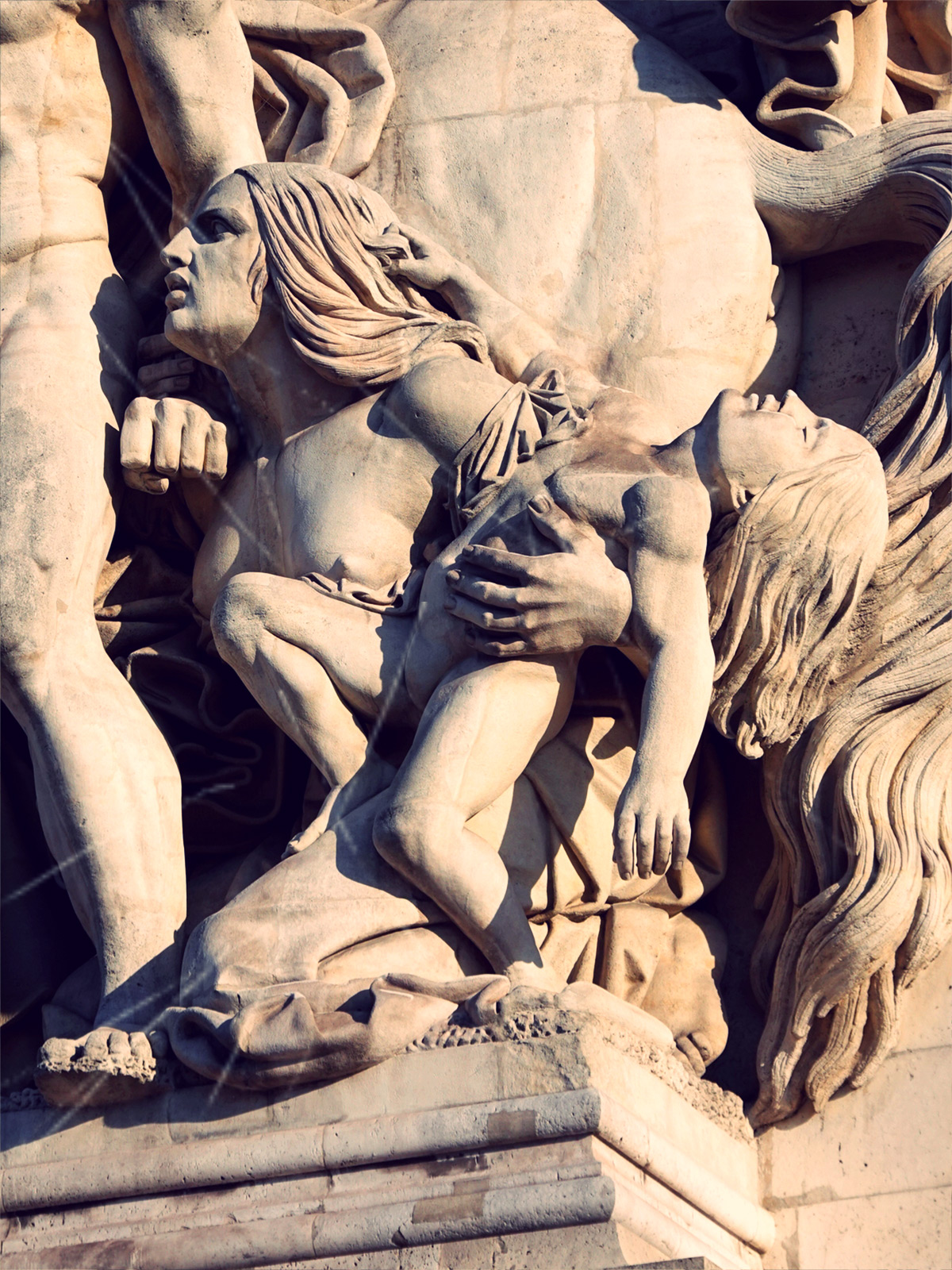
- The woman and child: a family threatened by war -
On the other side of the warrior, a woman holds a child in her arms and, like the old man, appears to be
trying to hold him back.
She is traditionally interpreted as his wife.
Her gesture conveys the anguish of a woman who risks losing her husband and being left to raise their child
alone.
The presence of the child adds another dimension to the scene: war does not threaten combatants alone.
It disrupts family life and jeopardizes the future of generations to come.
The group thus expresses a conflict between two duties: remaining with one's loved ones or setting out to
defend the wider community to which they themselves belong.
The maternal figure reminds us that the homeland is not an abstraction.
It is also made up of homes, families, children, and ordinary lives that invasion places in danger.
- The falling raider: the patriot’s sacrifice -
In the background, a bearded horseman, without armour, collapses from his mount as though he has just been
struck a mortal blow.
His unbalanced body contrasts with the upright stance of the young warrior.
While the latter is preparing to fight, the horseman reveals what the outcome of battle may be: injury, defeat,
and death.
The absence of armour reinforces the figure’s vulnerability.
He appears as a man exposed to danger, rather than an invincible hero protected by a breastplate.
He symbolizes the sacrifice of the patriot who gives his life to defend his country.
His fall reminds us that courage does not guarantee survival, and that resistance comes at a very real human
cost.
- The spirit of the future: the call of duty and hope -
Above the figures, a winged figure dominates the composition.
This is the Spirit of the Future, recognizable by its outstretched wings, its sword, and the flame appearing
on its forehead.
Its elevated position gives it an allegorical dimension: it does not represent a historical figure, but rather
a symbolic force that transcends individuals.
Its gesture seems to impress upon the warrior his duty to resist.
It embodies the call to continue the fight despite fear, the family’s pleas, and the threat of death.
The flame on its forehead evokes light and the future.
In this sombre scene, it introduces the idea that present sacrifice can help preserve the nation’s future.
The Spirit does not erase the suffering of the figures; it gives it a collective meaning.
It represents the ideal in whose name the warrior agrees to depart.
The most important symbols in the sculpture
The power of the relief lies in the contrasts between its figures.
| Element depicted | Meaning |
|---|---|
| The sword | Armed defence and the duty to act |
| The clenched fist | The will and the determination |
| The old man who holds the warrior | The family ties and the fear of loss |
| The woman and the child | The family, vulnerability, and the threatened future |
| The falling horseman | Death and the patriotic sacrifice |
| The wings of the Genius | The superior dimension of the ideal that guides the action |
| The flame on the forehead | Symbolic light and hope for the future |
These elements do not function in isolation. They come together to form a visual narrative in which patriotic duty clashes with family bonds, the impulse to fight meets the fear of death, and human suffering is set against the hope of a future preserved.
Why is the warrior surrounded by his family?
The warrior is surrounded by his family to highlight the personal cost of military service.
In traditional military sculpture, the hero is often surrounded by soldiers, trophies or symbols of victory.
Here, Étex chooses instead to place figures embodying private life around the warrior.
The old man and the woman are not mere witnesses.
Their gestures convey what his departure entails: separation, anxiety and perhaps bereavement.
The warrior thus finds himself at the heart of a dilemma.
He is torn between two opposing forces:
- The love of his family, who ask him to remain alive and present with his family.
- The duty towards the homeland, which imposes upon him the obligation to defend the country where those he loves live.
This opposition gives the sculpture moral depth. Courage is not presented as the absence of fear or
attachment.
It consists in taking action despite the legitimate reasons that might lead the warrior to remain with his
loved ones.
It is important, however, to remember that this interpretation belongs to the monument’s patriotic narrative:
it glorifies individual sacrifice in the service of the nation, without showing the different ways in which
people may have experienced or judged this war.
Why is it titled the resistance rather than the defeat of 1814?
The title profoundly shapes the way we view the scene.
The year 1814 ends with the fall of Paris, Napoleon’s abdication and the collapse of the First Empire.
From a military and political standpoint, it is a major defeat.
Yet Étex chooses to emphasize resistance rather than the downfall of the regime.
This choice allows us to shift the meaning of the event: even if France loses the war, the will to defend
its territory can be celebrated as a manifestation of national courage.
The sculpture does not therefore represent a military victory.
It values the act of resistance itself, regardless of its outcome.
This is an essential distinction: the hero is not glorified because he wins, but because he is willing to
defend his homeland despite the risk of defeat.
The romantic style: a scene of suffering and tension
Antoine Étex gives his relief a powerful dramatic intensity.
The movement is perceived in the lines and forms, which are not static but alive.
The bodies are not arranged in a solemn immobility.
They lean, cling, fall or stretch towards an opposing direction.
The gestures make visible the internal conflicts.
The composition opposes notably:
- The verticality of the warrior to the fall of the cavalryman.
- The movement towards the battle to the gestures that try to hold back the young man.
- The distress of the family to the determination of the fighter.
- The present suffering to the symbolic call of the Genius of the Future.
This expressiveness links the work to the romantic sensitivity of the 19th century, which favors strong
emotions, contrasts and dramatic situations.
The sculpture does not only seek to represent a historical event: it wants to make the viewer feel the weight
of the choice and the price of the sacrifice.
The connection with peace: two sculptures in dialogue
On the façade facing Avenue de la Grande-Armée, *La Résistance* stands opposite *La Paix*, also sculpted
by Antoine Étex.
Together, the two works form a complementary pair.
La Résistance depicts the danger, struggle and sacrifice required to defend the nation.
La Paix, by contrast, represents the return to civilian life, agriculture, family and the activities that
enable a society to prosper.
The contrast is significant:
- In La Résistance, the sword is ready to serve and the bodies express the tension.
- In La Paix, the soldier puts away his sword, while the plow, the farmer and the family evoke the return to daily life.
One depicts the duty to protect the nation; the other shows what that protection is meant to preserve.
Together, the two reliefs propose a story: the resistance against the invasion, then the return to a
peaceful existence.
On the left: La Paix (Peace), 1815.
| Sculptor | Antoine Etex |
| Year | 1837 |
| Location | West Façade, Neuilly Bridge Side |
| Evocation | Year 1815. |
The meaning of this work is essential: peace is not merely the absence of war; it allows people to find
their work, their families, and the stability necessary for the prosperity of the country.
However, the title refers to a complex historical year.
In 1815, after the return of Napoleon during the Hundred Days, his defeat at Waterloo and his abdication,
France experiences a new allied occupation and signs the second Treaty of Paris.
The Peace depicted by Étex is therefore less a portrayal of a specific historical event than an expression of
the ideal of reconciliation and a return to order.
The Peace thus emerges as a collective endeavour: it must be protected, nurtured and translated into the
tangible conditions of everyday life.
It allows families to rebuild their lives, children to learn and workers to resume their productive activities.
Where La Résistance glorifies the courage required to defend the nation, La Paix shows what that defence is
meant to preserve: everyday life, knowledge, cultivated land and the future of generations to come.
The soldier sheathing his sword: the end of hostilities.
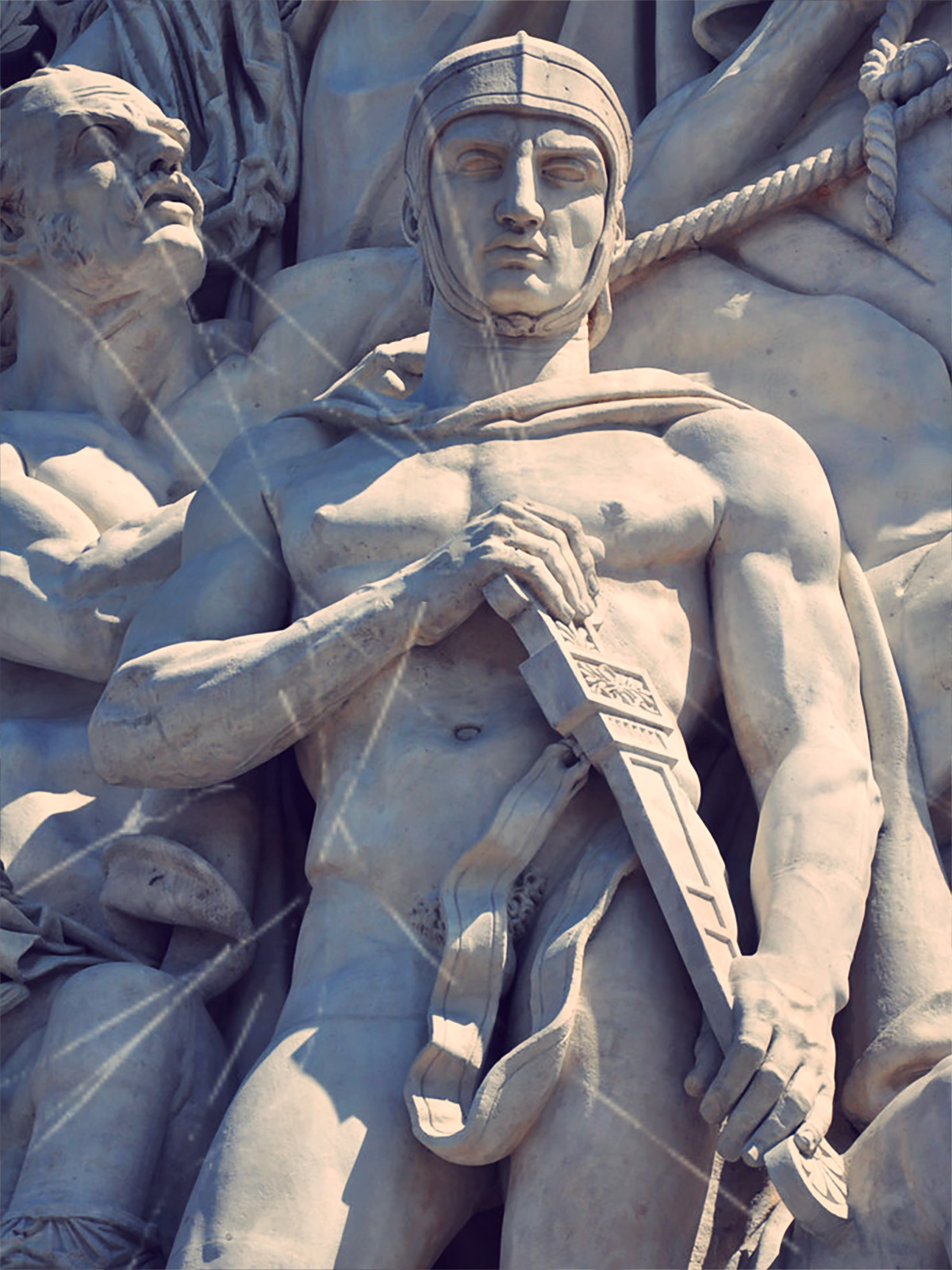
At the centre of the composition, a naked, helmeted soldier returns his sword to its scabbard.
This gesture lies at the symbolic heart of the entire sculpture: the weapon is no longer raised against an
enemy but put away, as the fighting must give way to peace.
His nudity follows the tradition of classical sculpture, in which the idealised human body conveys strength
and heroism.
The helmet recalls his identity as a combatant, while the act of sheathing his weapon marks a change in his
role: the soldier is no longer required to fight, but to safeguard the order that has been restored.
Unlike the warrior in La Résistance, who is preparing to go into battle, the soldier in La Paix performs
a gesture of withdrawal.
The two sculptures echo one another in almost every gesture: one expresses the need to take up arms, the
other the need to lay them down.
Minerva: the wisdom that safeguards peace.
Above the group stands Minerva, recognisable by her helmet and spear.
She is the Roman goddess of wisdom, warfare, and crafts.
In Roman mythology, she is associated with wisdom, military strategy, the arts and the civilising pursuits.
Her presence may seem paradoxical in a work devoted to peace, since she is also a warrior goddess.
This is precisely what makes her role so interesting: she represents not the blind violence of combat, but a
controlled force, capable of defending the city and safeguarding the conditions necessary for collective life.
Her commanding position allows her to watch symbolically over the figures below her.
Peace is therefore presented not simply as the absence of conflict, but as something that requires protection,
organisation and political wisdom.
The monument's educational guide also mentions an olive tree associated with this figure, a traditional symbol
of peace.
The mother and her children: the family reclaims its future.
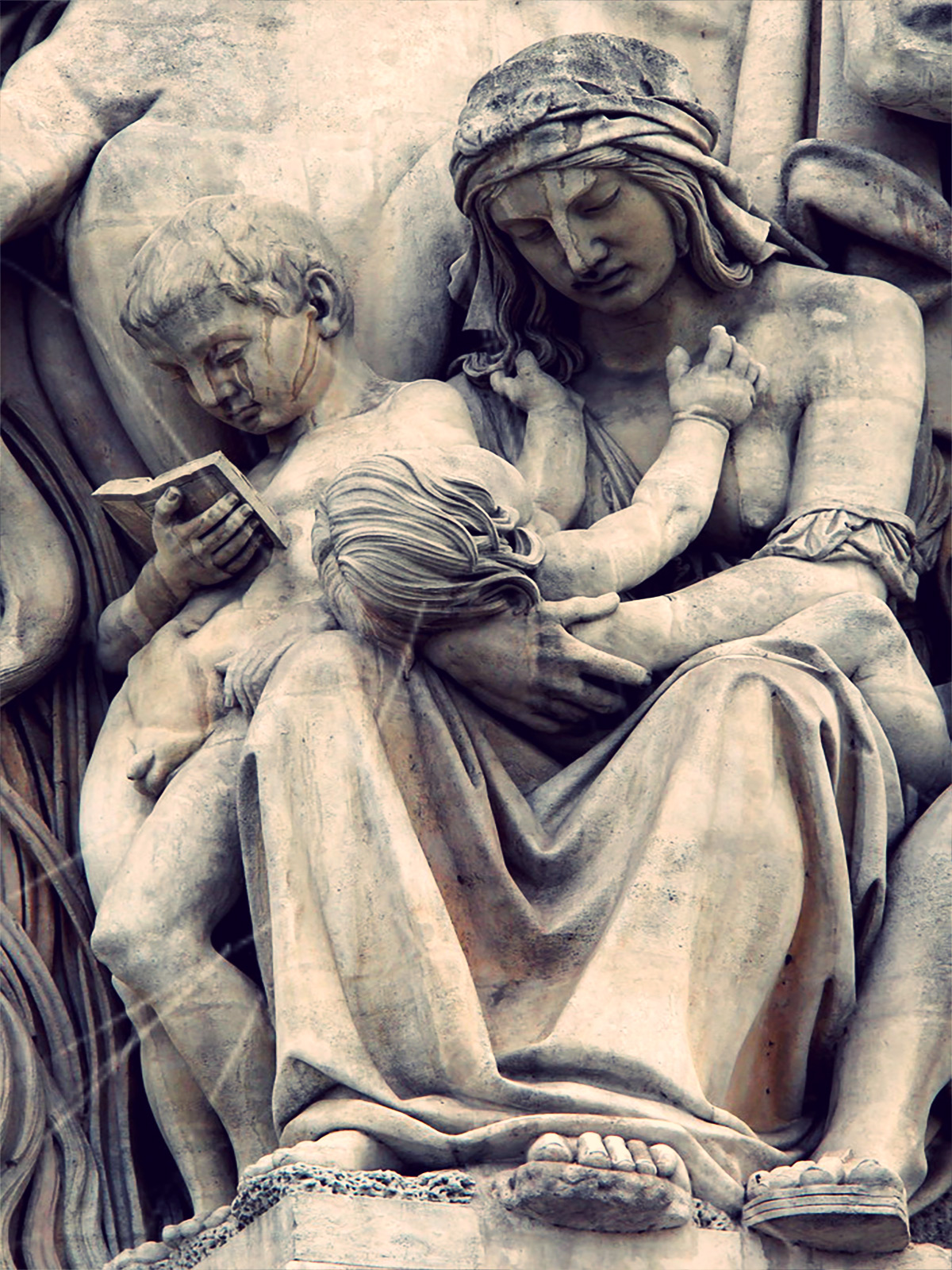
On the left, a mother holds her young child on her lap.
Beside her, an older boy is reading a book.
These figures represent two fundamental aspects of peace: the protection of the family and the opportunity to
pass knowledge on to future generations.
The mother and her young child
The mother embodies the continuity of family life.
After wars, departures and losses, she can once again care for her child in an environment no longer dominated
by military urgency.
The child also symbolises the future of the nation. He belongs to a generation that may grow up without
experiencing the same upheavals.
The boy reading
The presence of the book is particularly significant.
It recalls how peace makes education, learning and intellectual development possible.
The boy is not holding a weapon or preparing to fight: he is learning.
The sculpture thus contrasts two forms of transmission: that of warfare and that of knowledge.
This scene gives peace a deeply human dimension.
It is not simply a matter of putting an end to battles, but of restoring society's ability to raise its
children and prepare them for the future.
The ploughman, the ox and the plough: the return to prosperity
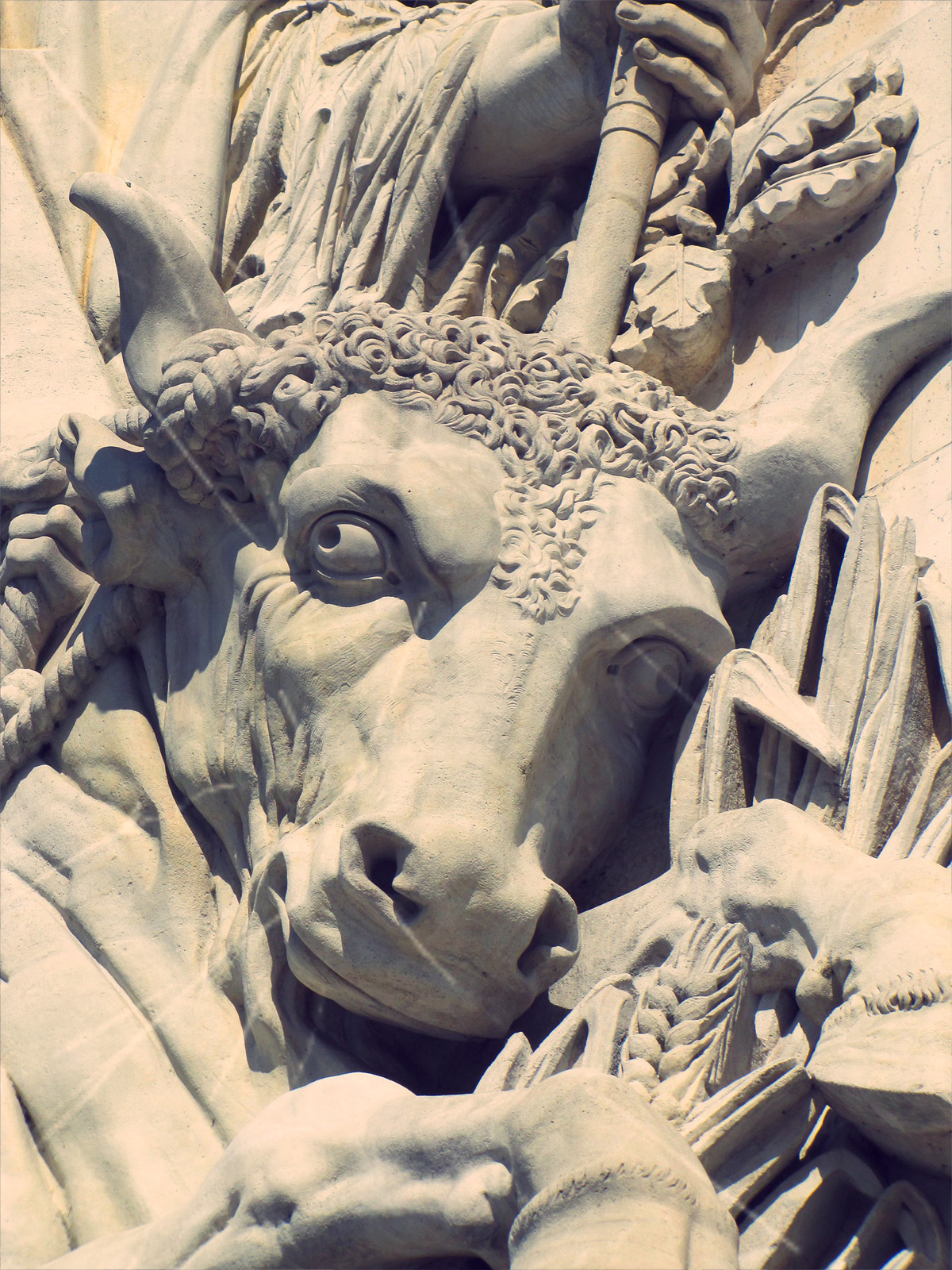
In the background, a ploughman struggles to guide his ox as he resumes working the fields.
His efforts are supported by the presence of a second figure, kneeling nearby, who examines the ploughshare.
Ears of wheat complete this agricultural scene.
The plough: replacing weapons with tools
The plough is one of the most eloquent symbols in the composition.
It represents productive labour, the preparation of the land and the return to activities that provide food
for the population.
Its significance becomes clear when it is compared with the soldier's sword.
The sword is put away, while the plough resumes its purpose. Instruments of destruction symbolically give way
to the tools that make it possible to produce and rebuild.
The ox: strength put in the service of life
The ox represents the animal strength required for agricultural labour.
Unlike the horse, which is often associated with warfare in military representations, the ox is depicted here
as taking part in an activity that feeds and sustains the community.
Its presence reminds us that prosperity also depends on daily labour, natural resources and the ability to
cultivate the land.
The ears of wheat: abundance and food security
Wheat evokes harvests, food and abundance.
After years of war, the return to flourishing agriculture means that the population can hope to regain a
measure of material security.
The relief thus establishes a direct connection between peace and prosperity: political stability allows
farmers to work, crops to flourish and families to enjoy a more secure and peaceful life.
The kneeling man examining the ploughshare: rebuilding through practical action
The figure kneeling beside the agricultural equipment is not directly involved in ploughing.
He is examining the ploughshare, the metal blade that cuts into the soil.
This detail emphasises that the return to peace does not happen overnight.
Tools must be repaired, equipment restored and work gradually resumed.
The man therefore symbolises reconstruction in practical terms, through ordinary yet essential actions.
Peace is not merely an abstract ideal embodied by Minerva: it is brought to life through those who work,
maintain their tools and prepare the harvests.
The kneeling posture does not signify the submission of a defeated enemy, as it does in certain
representations of triumph.
Here, it is associated with a practical activity, directed towards the land and the work itself.
This distinction is important: in *La Paix*, bent bodies are no longer necessarily signs of defeat.
They can instead express useful effort, preparation and reconstruction.
The symbols that give the sculpture its unity
| Element depicted | Meaning |
|---|---|
| The soldier sheathing his sword | The end of hostilities and the return to civilian life |
| Minerva and her spear | The wisdom, strategy and protection of the city |
| The olive tree | Peace and reconciliation |
| The mother and the child | The family and the continuity of life |
| The boy reading | Education and the future of generations |
| The farmer and the bull | The return to agricultural work |
| The plow and its share | Reconstruction and the resumption of productive activities |
| The ears of wheat | Abundance and food security |
The composition thus brings together the essential conditions of a prosperous society: security, family, education, agriculture and work.
Why is la Paix the counterpart to la Résistance?
The two reliefs by Antoine Étex are conceived as complementary scenes on the façade of the Arc de Triomphe
facing Avenue de la Grande-Armée.
In La Résistance, the warrior prepares to defend his homeland.
His family tries to hold him back, a horseman falls, and the Spirit of the Future urges him to fight.
In La Paix, the soldier sheaths his sword, the mother cares for her child, the boy reads, and the farmers
resume their activities.
The contrast tells a story of transformation: the nation moves from danger to reconstruction, from military
urgency to civilian stability.
Peace does not deny the sacrifice depicted in La Résistance.
It reveals its purpose: to preserve a world in which families can live, children can learn, and workers can
return to their occupations.
The historical context of 1815: A fragile peace
The title must be understood within the historical context of this turbulent year.
After Napoleon's first abdication in 1814, his return to power during the Hundred Days led to his defeat at
Waterloo on 18 June 1815, followed by his second abdication.
The Second Treaty of Paris, signed on 20 November 1815, established the terms of peace following this
defeat.
It imposed territorial and financial conditions on France and was accompanied by an Allied occupation.
The peace celebrated by Étex therefore does not mean that France immediately returned to an easy situation
free from tensions.
Rather, it expresses a longing for stability after decades of revolutionary and military upheaval.
It should also be remembered that the relief was sculpted between 1833 and 1836, long after these events.
It is an allegorical representation conceived with the benefit of hindsight, as part of a monument that
brings together several episodes from the nation's history.
Home · The whole History section · Lire en français
Back to top