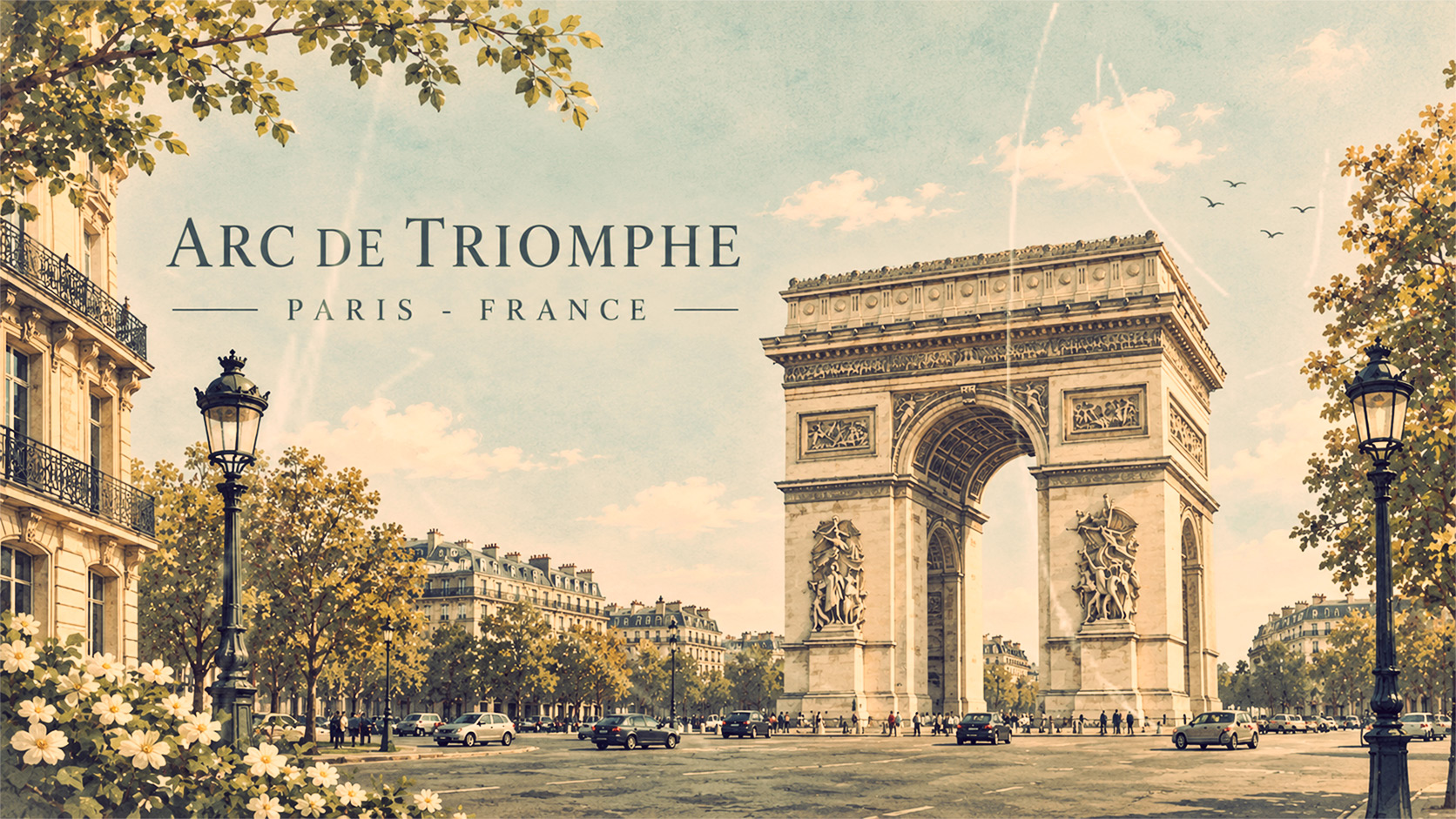
05Champs-Élysées Façade
On the right: The Departure of the Volunteers of 1792
| Other names | La Marseillaise or The Song of Departure |
| Sculptor | François Rude (1784-1855) |
| Year | 1835 |
| Location | Tuileries Side |
This work represents more than just the departure of soldiers: it symbolizes the awakening of the French people, their attachment to liberty, and their determination to defend the homeland under threat.
Historical Context: France in Danger
In 1792, the French Revolution was threatened by European monarchies that feared the spread of revolutionary ideas.
France entered into war with several foreign powers.
Facing this threat, the Legislative Assembly organized the mobilization of thousands of men to defend the
territory.
The French victory at Valmy on September 20, 1792, became one of the great symbols of this resistance.
More than 40 years after these events, during the reign of Louis-Philippe, François Rude was commissioned to
depict this collective surge of patriotic fervor.
The sculptor did not seek to recreate a historical scene faithfully; rather, he aimed to convey the energy,
courage, and enthusiasm of a people rising up to defend their country.
The Meaning of the Figures
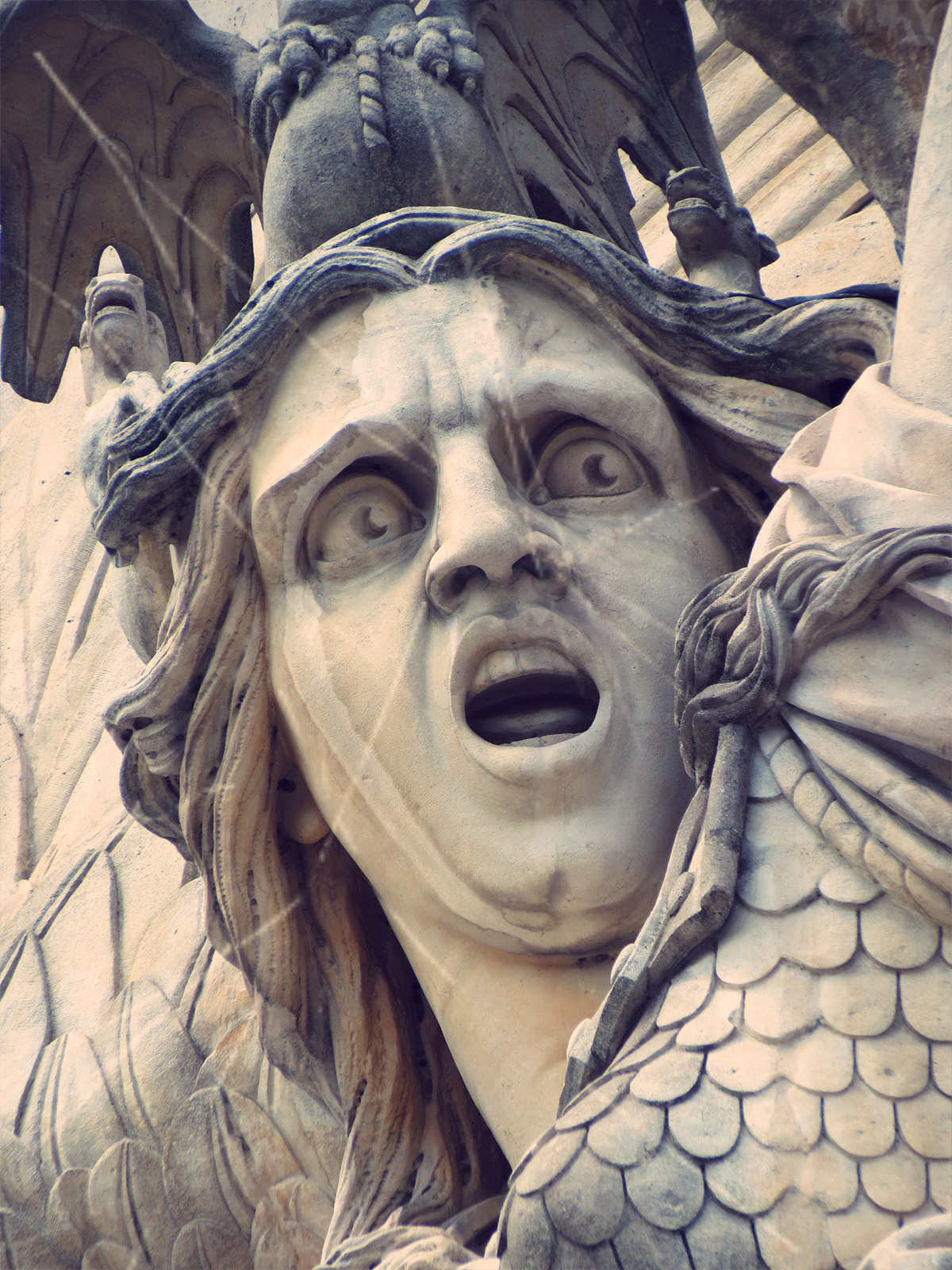
- The Winged Woman: Liberty and the Homeland -
She is the central and most dramatic figure.
With her mouth wide open, eyes wide, and arm outstretched, she appears to be shouting a rallying cry.
She brandishes her sword and leads the men into battle.
Wearing the Phrygian cap, a symbol of the French Revolution, she embodies Liberty, the Nation in Danger, and
revolutionary fervor.
She would also come to be interpreted as a precursor to Marianne, the personification of the French Republic.
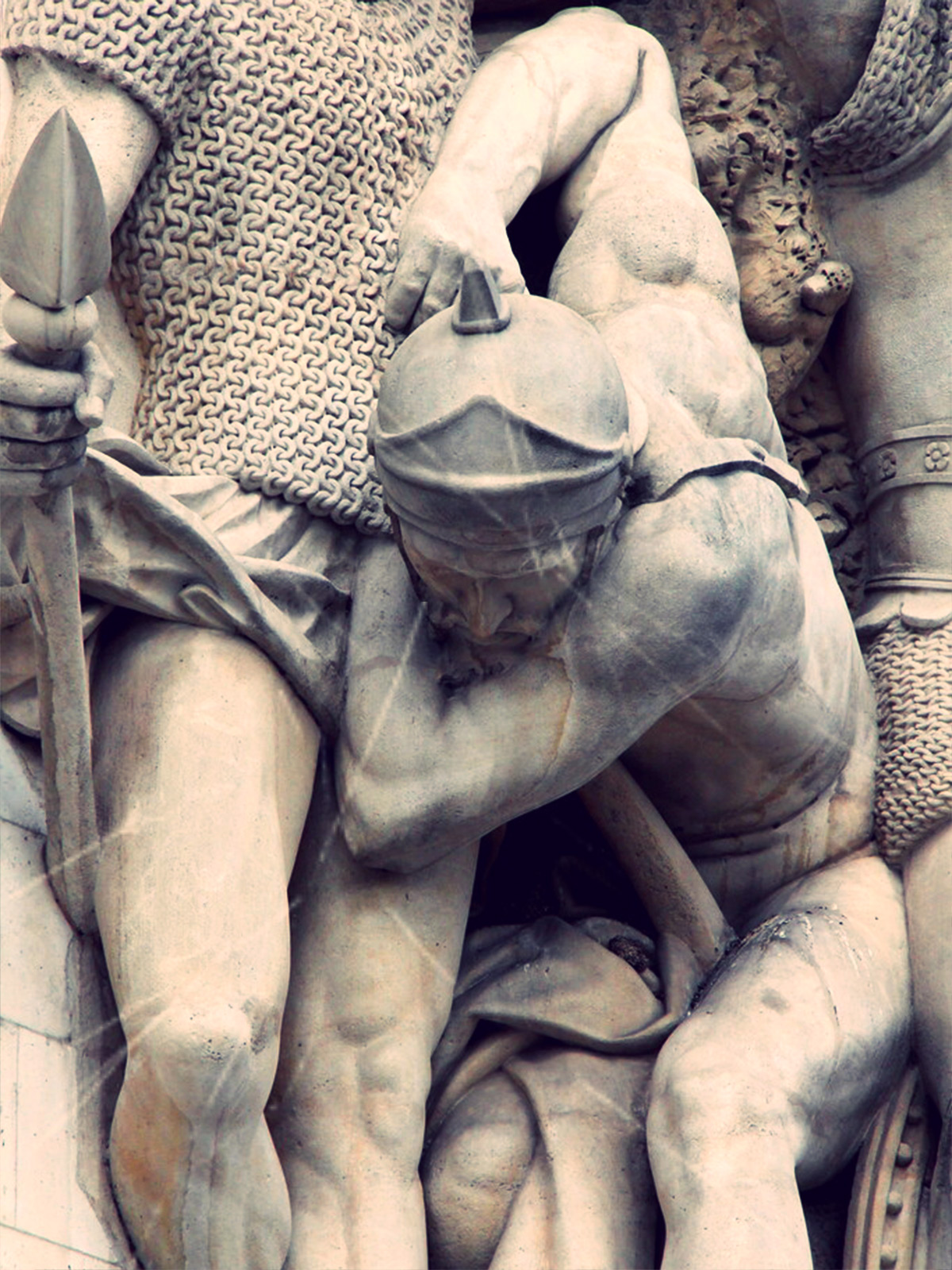
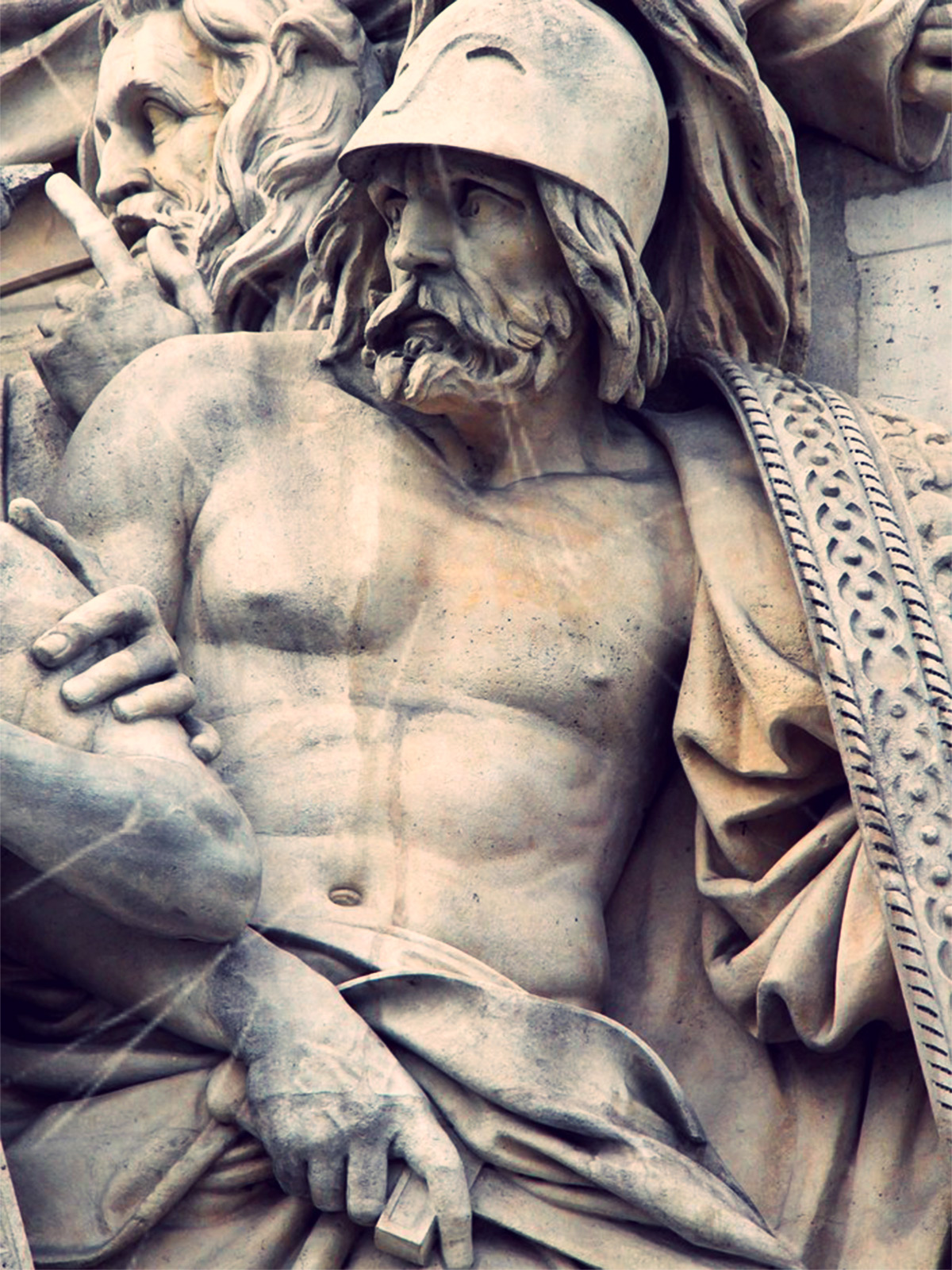
- The bearded warrior: strength and experience -
Beneath the winged figure, an armored, bearded warrior urges a young man forward, grasping him by the
shoulder.
His gesture expresses determination and the passing on of the duty to defend the homeland.
He embodies the strength of a mobilized people, ready to take up arms despite the dangers.
- The old man and the young man: generations united -
The old man standing at the back appears to be offering advice to the young fighter.
The latter, depicted nude, is being drawn into action by the warrior.
Their presence evokes the union of generations: the wisdom and experience of the elders stand alongside the
youth and fervor of those setting off for battle.
On the left: The Triumph of 1810
| Other names | The Triumph of Napoleon or The Apotheosis of Napoleon I |
| Sculptor | Jean-Pierre Cortot (1787-1843) |
| Year | 1833 |
| Location | Tuileries Side |
| Evocation | The Treaty of Schönbrunn or the Treaty of Vienna, signed between France and Austria in 1809. |
The Triumph of 1810 is a monumental high-relief sculpture created by sculptor Jean-Pierre Cortot for the
Arc de Triomphe.
Located on the façade facing the Champs-Élysées, this sculpture celebrates the power of Napoleon I and the
achievements of his Empire.
It particularly evokes the year 1810, a period when military conquests, diplomatic power, and the imperial
marriage seemed to secure the greatness and lasting future of the regime.
It symbolizes the height of Napoleonic power and the Emperor’s desire to have his glory endure for eternity.
Historical context: why the year 1810?
In 1810, Napoleon was at the height of his power.
Following several successful military campaigns, much of Europe was under his direct or indirect influence.
That year was also marked by his marriage to Marie Louise of Austria, celebrated in Paris on April 2, 1810.
This union, which brought Napoleon closer to the Habsburg dynasty, was of major political significance: it
was intended to strengthen his imperial legitimacy and secure a dynastic succession.
The sculpture therefore brings together two dimensions of his power:
- Military glory, achieved through conquests and victories.
- Imperial legitimacy, strengthened by his marital alliance with a great European royal house.
However, it should not be understood as an exact representation of a single event that occurred in 1810.
It is rather an allegory of the power and glory of the empire at that time.
The meaning of the characters
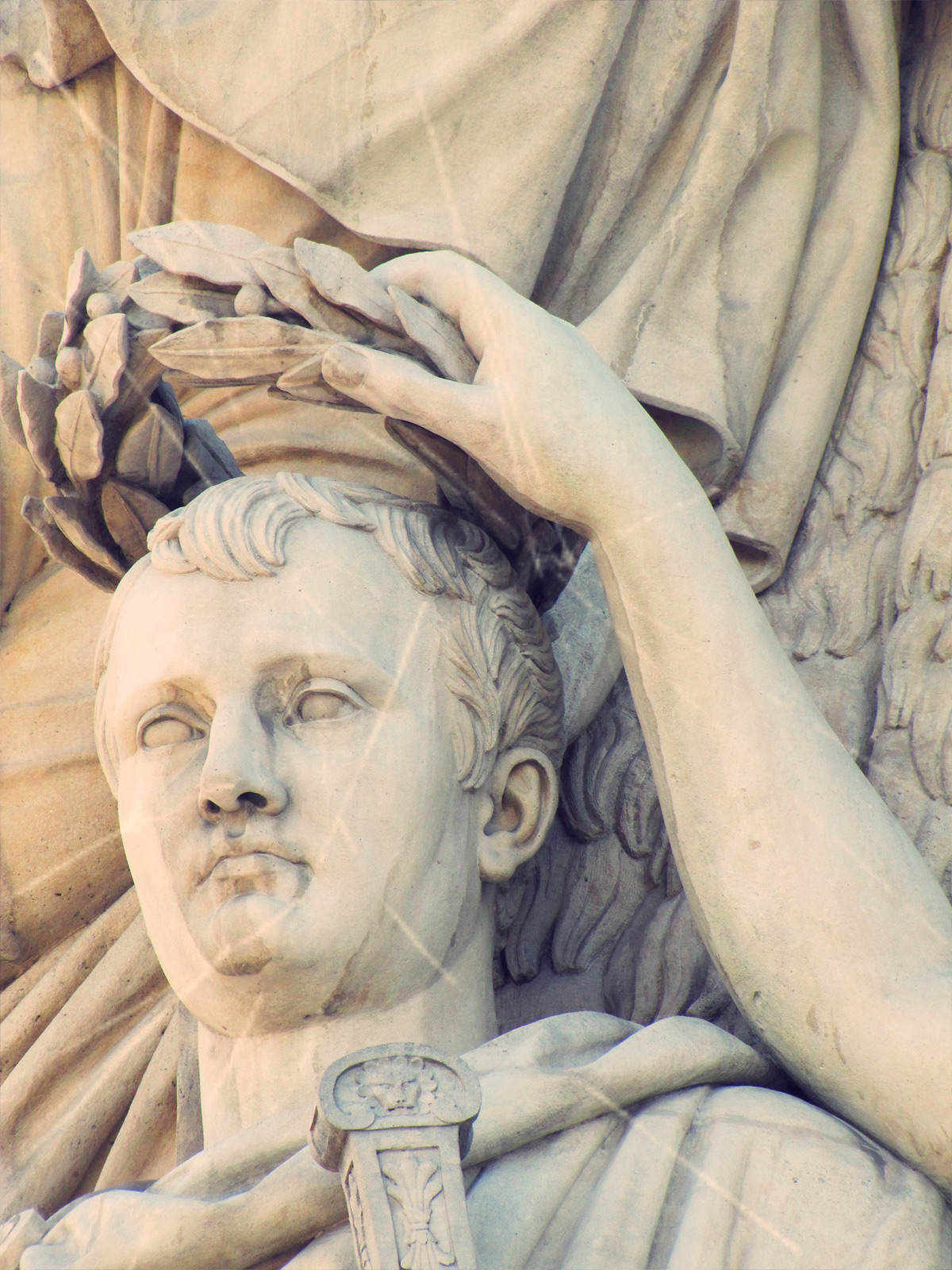
- Napoleon I: The Victorious Ruler -
At the center of the composition, Napoleon is depicted in a solemn pose, dressed in the style of antiquity,
like the Roman emperors.
He holds his sword close to his body and stands with an almost timeless majesty.
This choice of attire is no accident.
By adopting the appearance of the rulers of antiquity, Napoleon is placed in the tradition of the great
conquerors and emperors of Rome.
He is not merely portrayed as a victorious general; he is elevated to the status of a leader whose glory
seems to be enshrined in History.
- Victory: The Consecration of Triumph -
A winged female figure crowns Napoleon.
She represents Victory, traditionally associated in ancient art with the goddess Nike.
The laurel wreath is an ancient symbol of military victory and glory.
By placing it on the Emperor’s head, the figure appears to acknowledge his achievements and consecrate his
dominion.
Napoleon thus emerges as the recipient of a victory that extends beyond the battlefield: his power appears to
be legitimized by a higher symbolic force.
- Fame: glory proclaimed to the world -
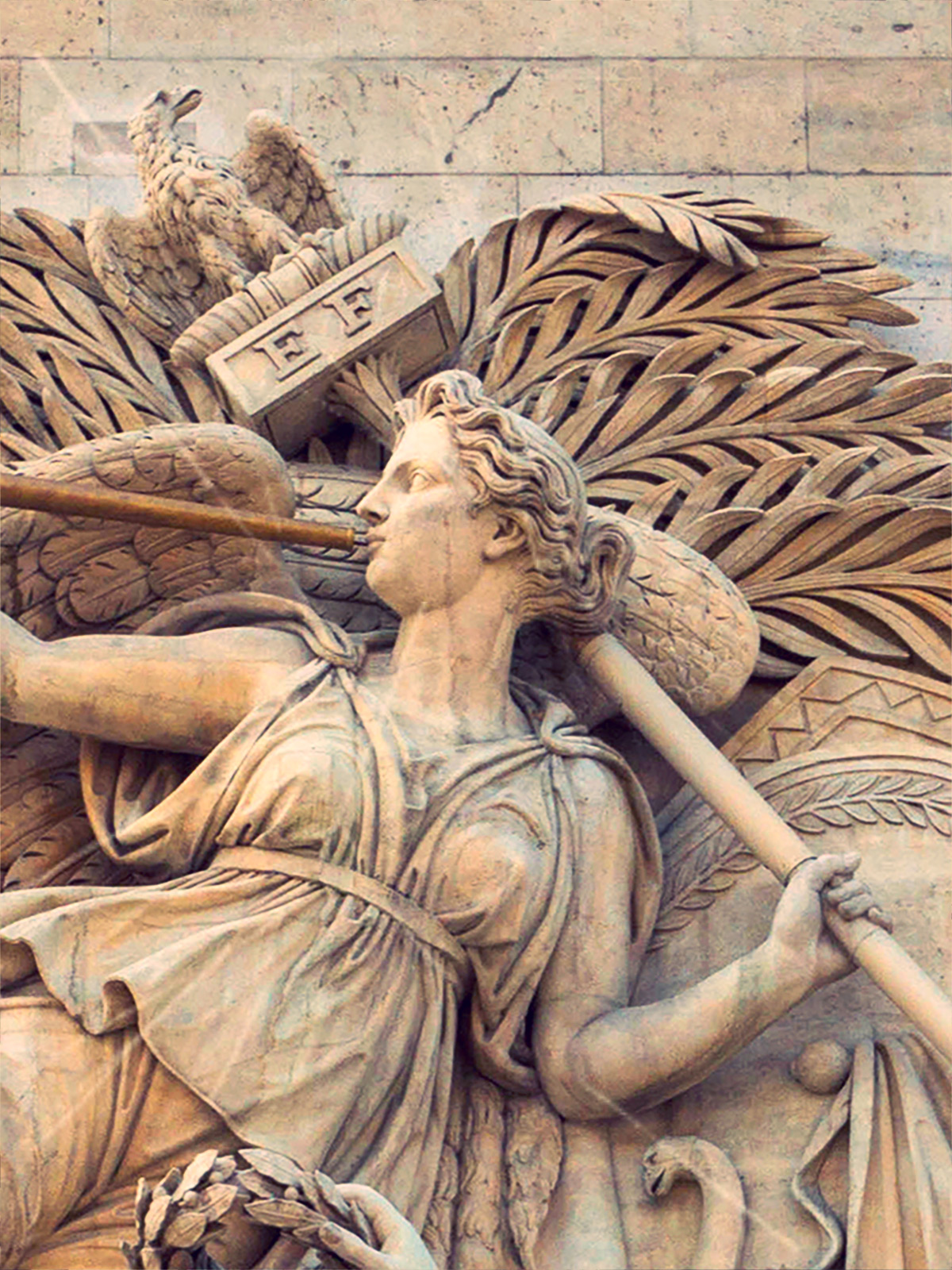
Above the scene, a winged figure blows a trumpet and raises a standard.
This is Fame, an allegorical figure who announces and proclaims the achievements of great men.
Her dominant position lends the scene a solemn quality.
Napoleon’s glory is no longer merely that of a leader celebrated by his soldiers: it is proclaimed to the
entire world and destined to endure through time.
The palm tree visible in the background alludes in particular to Napoleon’s campaign in Egypt.
- The kneeling prisoner: the submission of the defeated -
To Napoleon’s right, a kneeling man with his hands bound presents a prisoner at the victor’s feet.
This posture clearly conveys the balance of power between the conqueror and those he has subjugated.
The bowed body and bound hands evoke defeat, captivity, and the loss of freedom.
The sculpture thus celebrates imperial victory while also revealing its other side: the submission of
conquered peoples.
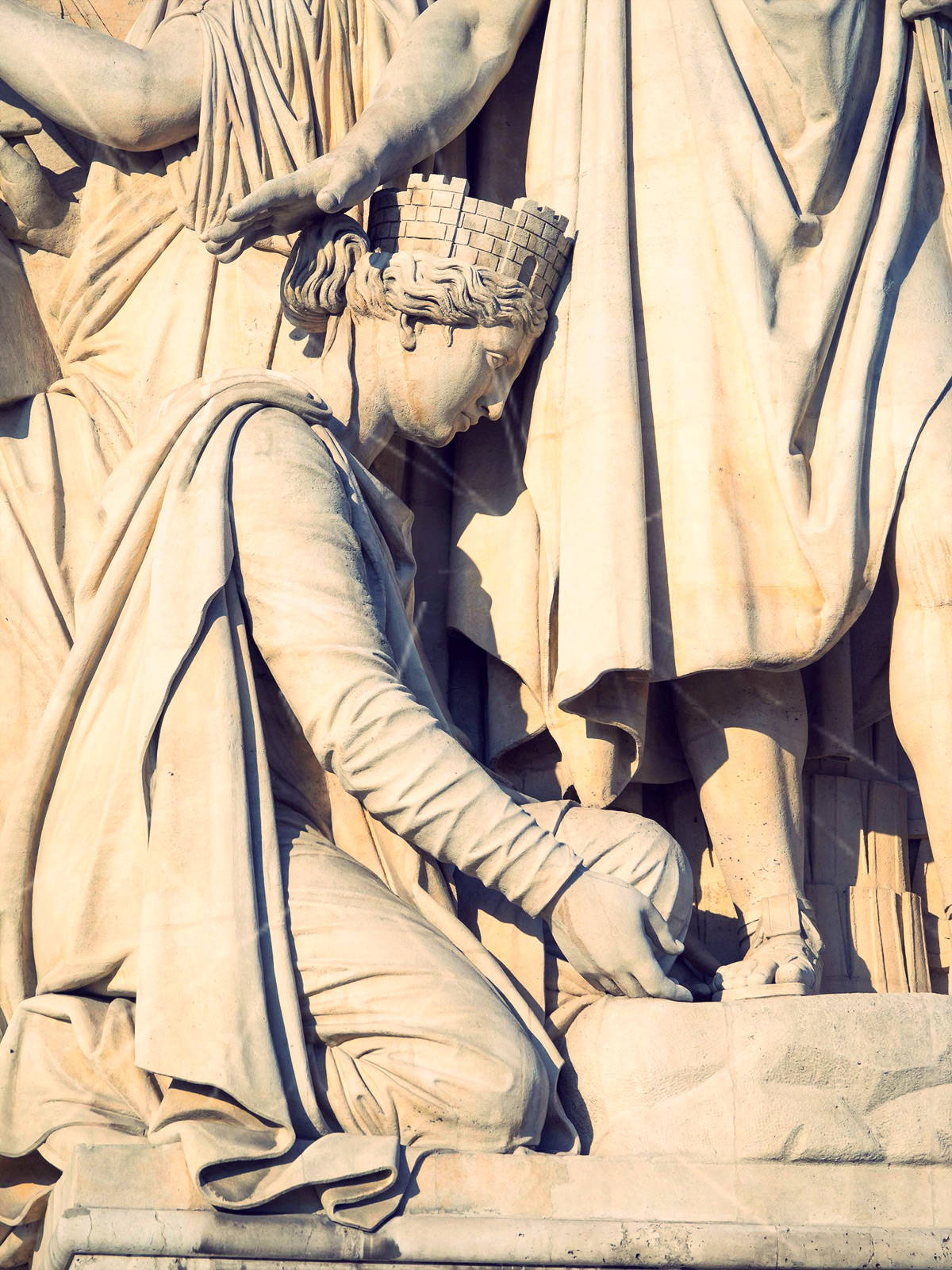
- The kneeling city: conquest, but also protection -
On the left, an allegorical figure representing a city kneels before Napoleon.
The Emperor extends a protective hand toward her.
This scene is particularly revealing of the political message conveyed by the work.
Military domination is presented not merely as a victory, but also as the establishment of an order for which
the sovereign is portrayed as the guarantor.
Napoleon’s gesture symbolically transforms conquest into protection: the man who subjugates peoples also
presents himself as the one capable of bringing them peace and security.
- The muse of history: preserving great deeds for posterity -
On the right, a serious woman records the Emperor's triumphs on a tablet.
She personifies History, which preserves the memory of events and transmits the legacy of great figures.
This detail gives the entire work its most enduring dimension: Napoleon's victories are destined to be
recorded, told, and commemorated.
The monument itself thus becomes the vessel of this imperial memory, as though the stone were meant to
secure Napoleon a place in History.
Why is Napoleon depicted in the manner of a roman emperor?
The ancient clothing is one of the essential elements of the sculpture.
In the 19th century, references to Greece and Rome allowed for the evocation of greatness, authority, civic
virtue and military glory.
By depicting Napoleon in a costume inspired by Antiquity, Jean-Pierre Cortot detaches him from his time to
make him a figure almost timeless.
This representation is rooted in the neoclassical aesthetic, which emphasizes harmonious proportions, the
clarity of the composition, and the dignity of the attitudes.
The contrast is interesting with François Rude's "The Departure of the Volunteers" of 1792, placed on the
same side of the Arc de Triomphe.
While Rude favors collective energy, sweeping gestures, and emotion, Cortot constructs an ordered, solemn,
and hierarchical scene centered around the Emperor.
A sculpture celebrating imperial power
The Triumph of 1810 does more than commemorate military victories.
It presents a vision of power itself.
| Element depicted | Meaning |
|---|---|
| Napoleon crowned by victory | The consecration of the victorious ruler |
| Fame and her trumpet | The diffusion of imperial glory |
| The prisoner with his hands bound | The defeat and submission of the enemies |
| The kneeling city | The domination presented as a protection |
| The muse of history | The conservation of the memory of the exploits |
The overall composition creates a coherent image: Napoleon is the conqueror, the protector, and the hero
whose victories are inscribed in the collective memory.
However, this is ultimately a commemorative discourse, not a neutral account of the Napoleonic conquests.
The sculpture emphasizes imperial glory and authority, without depicting the suffering and human losses
caused by the wars.
Home · The whole History section · Lire en français
Back to top